
The Pro-Slavery Expressive Acts

Today in class I learned about the pro-slavery movement and the events that contributed to it. Here are a few things I learned: 

The Fugitive Slave Act was a set of two laws that were put into place in 1793 and 1850 that essentially allowed the capture and return of a fleeing slave. The first act was passed to give the locals authority to capture and return a slave, but the second one was passed to help the south retain their slave supply. This set of acts was passed to increase the division between the north and the south. Because the north wasn't as supportive of slavery, many slaves fled the south to the north where they could live and roam freely. But with the new act passed, it was now the north's obligation as legal citizens to contribute to slavery. This act was really the south's strategy to manipulate the north into going against its morals. The two acts were repealed on June 28th, 1864. 

Fugitive Slave Acts | Definition & History | Britannica  Social Welfare History Project Fugitive Slave Act of 1850


Another pro-slavery expressive act I learned about what the Missouri Compromise of 1820. People who held authority at the time were pro-slavery and therefore wanted to be declared as a slave state, but the majority of the citizens of the US wanted to be a free state. As the United States continued to divide itself on the issue of slavery, Congress passed a law in which Missouri was admitted as a slave state but Maine was admitted as a free state. A line was drawn between the two territories which in my opinion only further emphasized how divided our country was. Looking back in the eyes of our government today, the Missouri Compromise was only a temporary solution to a long-term problem. For this exact reason, though it did spark lots of controversy, the Missouri Compromise was deemed unconstitutional in 1857 by the Supreme Court through the Dred Scott v. Sanford case. 
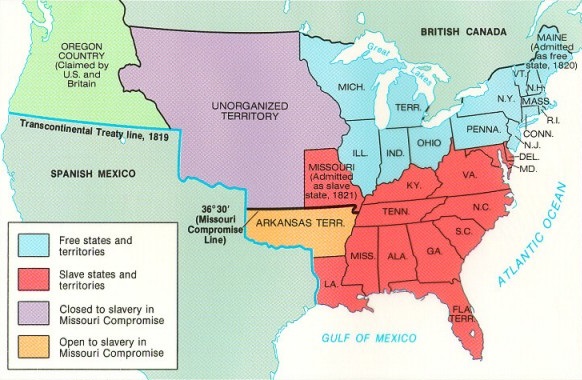
Missouri Compromise 1820 map


Comments

Popular posts from this blog

Glory

A few days ago in my seminar class, we watched a movie called "Glory". "Glory" depicts the story of the 54th Infantry Regiment in Massachusetts during the American Civil War. It shows the difficult and at times, uncomfortable story of the transition from slave to soldier. The men may have freed themselves from slavery, but they have yet to be free from the stigma that slavery created around them.  This movie was packed with tons of significant moments but I think my favorite was when Robert Shaw (played by Matthew Broderick) decided to take matters into his own hands when acquiring supplies for his soldiers. The men were denied basic attire like socks, shoes, and military uniforms due to the racial discrimination that they were still facing. Shaw wouldn't stand for it anymore and went to talk to the man in charge of attire. I think this is a great representation of what white people need to be doing in America right now. They need to use their privilege to upli...

My Thoughts on Gone With the Wind

I recently watched the movie "Gone With the Wind" in my seminar class: here are my thoughts. I mainly want to focus on one thing: the representation of African Americans in the film. Specifically focusing in on the characters Mammy and Prissy.  The two main black characters in the film are Mammy, played by Hattie McDaniel, and Prissy, played by Butterfly McQueen. This movie portrays the complicated dynamics and stereotypical box black women are put in. For one, I loved seeing the relationship between Scarlett and Mammy. We can see throughout the film that Mammy is the one who basically raises Scarlett. She cooks her meals, is always making sure she eats, she helps her get dressed, makes sure she's on time, and so on and so forth. One might think that this makes Mammy look submissive to Scarlett, and literally, she IS. But when we dive deeper into Mammy's attitude and personality, she is exactly the opposite. Through her interactions with Scarlett, we see Mammy being a...

The Jim Crow Era and Brown v. The Board

Today in seminar I learned about two things: Brown v. Board and the Jim Crow Era. It was weird to learn about some of these things, because they seem so inhumane and so outdated. But the truth is that some of these things are still very much present in this country, such as blackface, a rising topic in media and entertainment, and lynchings, something that is still happening today in the midst of the rise of the Black Lives Matter movement.  Lynchings started occurring in the late 1870's and continued to occur for almost a hundred years. It was used as a form of punishment for black people who committed any type of social aggression, ranging from an accusation of a crime to something as small as bumping into a white woman, and the accuses weren't even given due process. Because white people didn't feel as if the law was working, they took the law into their own hands. The people that were responsible for these crimes were never charged or arrested. There was a total of abou...